INTRODUCTION
Adobe Inc. is one of the world’s leading software companies, best known for its Creative Cloud suite that includes Photoshop, Illustrator, Premiere Pro, and After Effects, along with its ubiquitous PDF format and Acrobat tools. Over more than four decades, Adobe has become deeply embedded in both creative industries and the broader business world, with its products used by design professionals, enterprises, governments, and everyday consumers alike. Since shifting from one-time software sales to a subscription model in 2013, Adobe has built a highly predictable, recurring revenue base that today makes up more than 95% of sales.
From an investment perspective, Adobe represents a high-quality compounder with wide moats built on network effects, switching costs, and brand dominance. Yet, despite strong fundamentals, the stock has experienced a sharp decline, falling more than 20% in the past year. At current levels, Adobe trades at roughly 23x earnings -multiple that is modest compared to its historical growth and profitability. This raises the question: is the market overly pessimistic, or is competitive disruption a real threat?
BUSINESS MODEL & REVENUE SOURCES
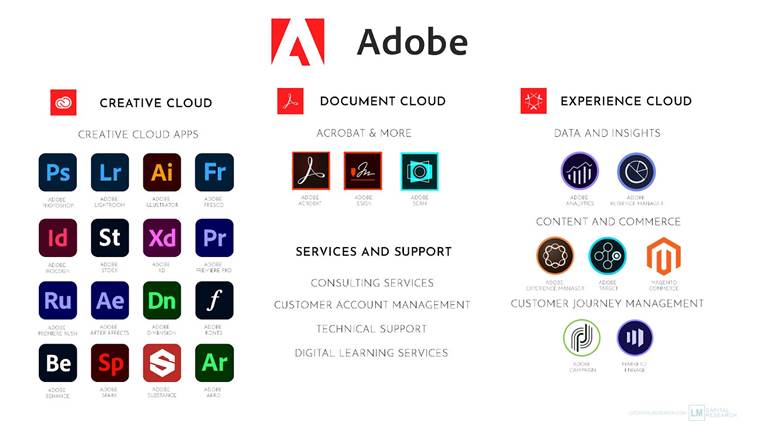
Adobe operates a diversified software-as-a-service (SaaS) business model centered around three main revenue pillars: Creative Cloud, Document Cloud, and Experience Cloud. Together, these segments give Adobe exposure to both creative professionals and corporate clients, generating a resilient mix of subscription-based revenue. Over 95% of Adobe’s sales now come from recurring subscriptions, a transition that began in 2013 when the company moved away from one-time software licenses. This shift has transformed Adobe’s financial profile, making cash flows more predictable, smoothing revenues, and reducing piracy. It also allows Adobe to bundle less popular tools with its flagship products, driving cross-selling and higher customer lifetime value.
Creative Cloud is the company’s largest segment, accounting for roughly 60% of revenue or $12.91 billion. It includes flagship products such as Photoshop, Illustrator, After Effects, and Premiere Pro, used by creative professionals across industries ranging from advertising and media to film, gaming, and design. In recent years, Adobe has also expanded Creative Cloud to reach non-professional users through Adobe Express, a simplified design platform targeting teachers, small businesses, and influencers. This broadens the company’s addressable market beyond its traditional professional base.
Document Cloud contributes about 15% of total revenue ($3.23 billion). The core of this division is Adobe Acrobat, which remains the standard for creating, editing, and signing PDF files. Acrobat, combined with Adobe Sign and related services, has become an indispensable tool for enterprises, governments, and legal and administrative workflows. Document Cloud diversifies Adobe’s business beyond creative professionals and into the global knowledge economy. Increasingly, Adobe is expanding Acrobat’s functionality to include more collaborative and visual features, positioning it as more than just a document tool.
Experience Cloud generates about 25% of revenue ($5.38 billion) and focuses on digital marketing, analytics, and customer experience management. This includes tools for content personalization, data insights, and ad performance tracking, enabling enterprises to deliver targeted customer experiences. Adobe has expanded this segment through acquisitions such as Marketo and Magento, building a full-service marketing platform. While not as dominant as Creative Cloud, the Experience Cloud allows Adobe to capture value across the entire lifecycle of digital content — from creation to distribution to measurement.
Adobe’s gross margins consistently exceed 85%, reflecting the near-zero marginal cost of delivering software to additional users once development is complete. This software economics, combined with scale, explains why operating margins average above 30%. Capital intensity is also extremely low. Capex typically accounts for less than 3% of revenue, since the business requires little in the way of physical assets. This asset-light structure enables return on invested capital (ROIC) in excess of 20%.
In terms of capital allocation, Adobe reinvests heavily in innovation while also pursuing acquisitions to extend its ecosystem. Although the failed $20 billion Figma bid highlighted risks in M&A discipline, past purchases like Marketo and Magento have strengthened its position in enterprise markets. Beyond reinvestment, Adobe has favored share repurchases over dividends, reducing its share count and boosting per-share earnings power. While buybacks can be an effective tool when shares trade well below intrinsic value, I am more cautious in Adobe’s case. As Charlie Munger once noted, some companies use repurchases merely to prop up their stock rather than as a disciplined deployment of capital. Given Adobe’s historical high valuation multiples, I would prefer management to prioritize reinvestment in growth opportunities or maintain financial flexibility instead of leaning too heavily on buybacks, but they may be prudent, if the management keeps repurchasing stock at current depressed levels.
INDUSTRY DYNAMICS
Adobe operates at the center of the global digital content and marketing industries, markets that continue to expand as more businesses and individuals create, distribute, and consume digital media. Industry projections suggest that demand for digital content creation tools will grow at high single-digit rates over the next decade, supported by trends such as the rise of social media, e-commerce, remote collaboration, and increasingly personalized marketing. This structural growth provides Adobe with a favorable backdrop, but also attracts strong competition.
At the low end of the market, Canva has built a massive user base of over 200 million people by offering simplified, affordable design tools for small businesses, teachers, and casual creators. Canva threatens to capture a generation of users who may never adopt Adobe’s professional-grade ecosystem, especially in education and small enterprise segments. In UI/UX design, Figma has emerged as the platform of choice for collaborative, cloud-based interface design. Adobe’s abandoned $20 billion acquisition attempt — and subsequent discontinuation of its competing Adobe XD product — demonstrated how far behind it had fallen in this niche.
Adobe also faces new pressure from AI-native design platforms such as MidJourney, Stability AI, and OpenAI’s image generation tools. These startups offer fast, low-cost content creation, which appeals to individuals and small businesses. However, they often lack the precision, integration, and legal safety required by enterprises. For large clients, concerns over copyright, data privacy, and branding consistency make Adobe’s licensed and commercially safe AI model (Firefly) a far more viable option.
Despite these pressures, Adobe maintains an exceptionally wide moat. Its Creative Cloud ecosystem remains the gold standard for professionals, with tools deeply integrated into corporate, media, and entertainment workflows. Switching costs are high, as creative teams are trained on Adobe software and projects are often structured around its file formats. On top of that, Adobe benefits from strong network effects: its file standards (PDF, PSD, AI) and interoperability across the suite have become industry norms, which reinforces adoption the more widely they are used. Enterprise clients, in particular, are far less price-sensitive and less likely to adopt cheaper or unproven AI substitutes in the short term, since consistency, IP safety, and workflow reliability outweigh cost savings. Moreover, Adobe continues to innovate, embedding generative AI tools such as Firefly directly into its platforms. Unlike many competitors, Firefly is built on licensed data, making its outputs commercially safe — a crucial differentiator for enterprises wary of copyright risks.
Looking ahead, Adobe benefits from both cyclical and secular growth drivers. The shift to digital-first marketing ensures steady demand for its Experience Cloud, while the democratization of design expands the market for entry-level tools like Adobe Express. Meanwhile, the professional creative economy remains dependent on its software, providing stability. In addition, Adobe still derives roughly 53% of its revenue from the United States, leaving meaningful room for international expansion as emerging markets grow and transition to digital. Since Adobe sells software, this expansion carries little incremental cost, making global adoption a powerful long-term growth lever.
INVESTMENT THESIS
Adobe represents a rare combination of steady growth, exceptional profitability, and a wide competitive moat. Returns on invested capital consistently top 20%, underscoring the company’s ability to generate superior profitability without requiring heavy capital expenditures. These fundamentals provide a solid foundation for long-term compounding.
Despite this, the market has grown increasingly concerned about competitive threats from emerging design platforms and generative AI tools. Adobe’s share price has declined by more than 20% over the past year, and today trades at about 23x. In my view, these fears are overstated. While lower-end competitors like Canva have captured casual users, Adobe’s dominance among professionals and enterprises remains intact. More importantly, generative AI does not represent an existential threat. Rather, it is likely to enhance Adobe’s value proposition.
Adobe has already integrated Firefly, its proprietary generative AI engine, into its Creative Cloud suite. Unlike many competitors that rely on scraping online content, Firefly is trained on licensed data, ensuring that its outputs are commercially safe and IP-compliant. This is a crucial differentiator for enterprise clients, who cannot risk copyright disputes. Early features, such as Photoshop’s Generative Expand, demonstrate how AI can significantly improve productivity without replacing the need for professional tools. In practice, AI lowers friction in the creative process, enabling more output and expanding the overall design market—which ultimately benefits Adobe as the industry leader.
Taken together, Adobe offers investors a high-quality business with enduring moats, strong cash generation, and exposure to secular growth in digital content and marketing. Current pessimism about AI disruption has created an opportunity to acquire this compounding franchise at a reasonable price. In my assessment, AI is less a threat than a catalyst, positioning Adobe to strengthen its dominance and accelerate long-term growth.
RISKS
Even though Adobe is a high-quality business with enviable economics, I would be doing myself and my readers a disservice if I didn’t also take a hard look at the risks. In the short term, the most obvious challenge comes from intensifying competition. Canva has become the tool of choice for a generation of younger users, teachers, and small businesses who want simple, cheap design without the learning curve of Photoshop or Illustrator. A former Adobe manager even admitted that much of the SMB segment is “shifting to Canva.” Figma, meanwhile, has established itself as the leader in UI/UX and collaborative design. Adobe’s abandoned $20 billion bid — and the $1 billion breakup fee it had to swallow when regulators blocked the deal — shows just how seriously Adobe viewed the threat. That deal’s failure not only left Figma independent but also handed it momentum, culminating in a hugely successful IPO in 2025. To me, this highlights the fact that Adobe is no longer the only dominant name in design software; it has to fight harder for the next generation of customers.
Another layer of risk comes from emerging AI-native platforms like MidJourney, Stability AI, or OpenAI’s image tools. These make it possible to generate passable designs in seconds, which could tempt small businesses or freelancers to bypass Adobe altogether. Adobe’s answer has been Firefly, its own AI engine, which has one crucial advantage: it’s trained on licensed data and therefore outputs IP-safe content. I think that makes it far more appealing to enterprises, but I can’t ignore the possibility that cheaper, free, or open-source AI tools could steadily chip away at Adobe’s lower-tier customers. There’s even some cannibalization risk: if users can accomplish more with Firefly’s AI tools, they might rely less on Adobe’s full suite — potentially reducing upselling opportunities.
Financially, Adobe’s elite margins are a double-edged sword. They show the strength of the model, but they also create pressure to defend them. To keep its lead in AI, Adobe is pouring billions into R&D and cloud infrastructure. If rivals innovate faster, these expenses may start to look like diminishing returns. On the other side of the equation, pricing power could weaken. Subscriptions are Adobe’s lifeblood, but if competitors offer good-enough alternatives, raising prices gets harder. The risk is that Adobe could face margin compression from both rising costs and limited pricing flexibility.
Regulation is another area where the Figma saga tells us a lot. Authorities in both the EU and UK made it clear they see Adobe as too dominant to be allowed to buy a major rival. That means Adobe will likely find it harder to use acquisitions as a defense mechanism in the future. I also wouldn’t rule out scrutiny of its bundling practices or its high market share in certain file formats. While nothing material has landed yet, the regulatory climate is only becoming tougher for large software players.
Finally, capital allocation deserves scrutiny. Adobe has authorized a massive $25 billion buyback program through 2028 and repurchased more than $12 billion of stock in just the last year. While buybacks can create value if done at the right price, I share Charlie Munger’s skepticism that many companies use them just to prop up the share price. Adobe’s stock traded north of 25× earnings while these buybacks were happening, and despite the spending spree the shares are still down more than 20% this year. That tells me buybacks won’t solve the fundamental questions around growth and competition.
Stepping back, I don’t see any single risk that “breaks” Adobe in the near term — the moat is still wide, and enterprise clients in particular are sticky and less price-sensitive. But over the long term, the cumulative effect of competition, AI disruption, regulatory oversight, and capital allocation missteps could narrow that moat. As an investor, I need to be comfortable not only with Adobe’s current financial strength but also with its ability to adapt and execute through these challenges. That, ultimately, will determine whether today’s concerns are temporary headwinds or the start of a more lasting shift in Adobe’s trajectory.
FINANCIAL ANALYSIS AND VALUATION
To properly evaluate Adobe as an investment, I didn’t want to rely on surface-level multiples or broad market sentiment. Instead, I built a detailed six-scenario discounted cash flow (DCF) model, designed to capture a wide range of possible futures for the business. The idea was to stress-test Adobe’s value across pessimistic bear cases, balanced base cases, and optimistic bull cases, each with its own assumptions about revenue growth, operating margins, and the durability of its competitive moat. For me, valuation is not about predicting the future with certainty — it’s about mapping out a range of plausible outcomes and then asking whether the odds are tilted enough in my favor to justify committing capital. To arrive at the cash flow inputs for my DCF, I first adjusted reported net income to approximate owner’s earnings. In Adobe’s case, this requires adding back non-cash charges (depreciation and amortization) and then subtracting an estimate of maintenance capital expenditures. Since Adobe is a capital-light software company, Capex has consistently run far below D&A — in 2024, Capex was $291M versus $934M in D&A. Most of the amortization relates to intangibles from past acquisitions that don’t need to be “replaced” with new cash outflows. Based on this, I assume maintenance Capex is roughly equal to reported Capex (~$300M annually), with the remainder of D&A treated as non-economic. This provides a more realistic measure of the true cash Adobe can distribute to shareholders, and it serves as the foundation for my scenario analysis. I also apply a strict personal hurdle rate of 15%. In practice, that means I require a potential investment to generate at least a 15% annualized internal rate of return (IRR) over the long run to qualify for inclusion in my portfolio.
In the bear scenarios, Adobe’s profitability erodes as competitive pressure mounts and AI fails to create new value – AI reveals itself as a threat to Adobe’s business. In the weak bear case, I assume average operating margins of 28% and near-flat net income growth of just 2.5% annually through 2034. That scenario produces a negative IRR of about –2.8% at today’s share price. The strong bear case is a bit less dire but still weak, with margins at 32% and growth of 5%, leading to an IRR of –0.1%. These cases have low probability in my view, but they illustrate the downside if Adobe’s moat truly narrows.
The base cases represent what I consider more realistic midpoints. In the weak base case, margins average 34% and earnings compound around 9% per year, producing an expected IRR of 4.2%. In the strong base case, margins stay at current levels of 36% and net income grows at 12% annually, implying a 7.5% IRR. These results line up with Adobe’s secular growth story but also highlight the valuation challenge: even if the company continues executing well, returns are modest from current price level.
The real upside lies in the bull scenarios, which assume AI integration actually expands Adobe’s moat rather than undermining it. In the weak bull case, I model 37.5% operating margins and 14% growth, yielding an 9.9% IRR. In the strong bull case, operating margin expand to 39% and earnings compound at 17% annually, with a terminal growth rate of 4%. That scenario, at current stock price, delivers a 17.5% IRR — finally clearing my 15% hurdle. But it requires a near-perfect outcome: successful AI monetization, global expansion, and no meaningful pricing erosion.
To anchor the analysis, I assigned probabilities to each scenario based on my qualitative view. Since I believe AI is more likely to help Adobe than hurt it, I skewed probabilities toward the stronger base and bull cases.
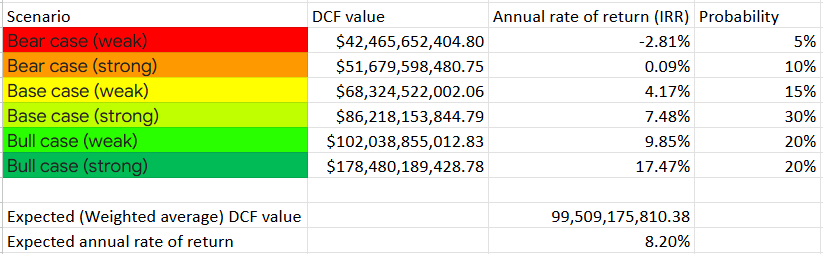
When I average those out, Adobe’s expected intrinsic value comes out to about $92 billion, and the weighted IRR is just 7.2%. At the time of writing, the stock traded at $348.50.
PORTFOLIO DECISION
When I step back from the numbers, the conclusion for me is fairly clear. Adobe is an exceptional company — one of the highest-quality software businesses in the world, with industry-standard products, a sticky ecosystem, and outstanding profitability. But as a disciplined value investor, I remind myself constantly that a great business is not automatically a great investment at any price. The purpose of my valuation exercise is to strip away market sentiment and force myself to ask: “If I owned this company for the next decade, would I achieve my 15% annual return target from today’s entry point?” Based on my scenarios and probabilities, the answer is no.
The weighted outcome of my DCF analysis points to an expected IRR of just over 7%. That is less than half of my required return and far too low for me to justify putting new capital to work. Yes, there is one scenario — the strong bull case — that delivers returns above my hurdle. But betting on that outcome would mean assuming near-perfect execution: AI adoption working entirely in Adobe’s favor, margins holding at the high end of their range, and global expansion playing out flawlessly. That kind of “all green lights” future is not how I like to build my portfolio. I prefer to invest where even the conservative base cases give me attractive returns, and the bull case simply provides upside. With Adobe, the setup is the opposite: I need the bull case to hit my target, and the base cases leave me well short.
For those with a lower return hurdle — say 8–10% — Adobe could be worth buying here, because it is highly likely to deliver that level of compounding over time. But for me, sticking to my 15% requirement keeps me disciplined and consistent. It also forces me to be patient. At the right price, Adobe would absolutely belong in my portfolio. Until then, it belongs on my watchlist. I will keep tracking the company’s fundamentals, monitoring how Firefly is adopted, and watching for any significant price dislocation that improves the implied return.