INTRODUCTION
For my first company analisis I’m choosing a danish comany Novo Nordisk A/S. As you may already know (since it’s a quite large corporation), Novo Nordisk is a pharmaceutical company that develops and produces mainly drugs for diabetes and obesity care. Because of it’s two blockbuster drugs – Ozempic and Wegoy – it archived astounding growth in both earnings and consequently in it’s valuation in last few years. But because of intensifying competition (mainly from Eli Lilly) and more recently profit guidance reduction and CEO transition, it’s stock has fallen more than 60% from its peak (almost 32% in just last 5 days) and it’s now trading at a P/E ratio of just 13. While I thought that the company was overvalued at the hights of it’s valuation, the recent drop sparked my interest in the stock. So now I’ll analize whether the market is overreacting on these recent developments and is offering a great company at a bargain price or the increased risks really justify the sharp decline in valuation and signal a potential shift in the company’s long-term fundamentals.
BUSINESS MODEL & REVENUE SOURCES
But first let’s look how the company operates and how and where it generates revenue.
Novo Nordisk is an originator pharmaceutical company, which means it develops its own proprietary drugs, which are patent protected, typically for 20 years. Those drugs are then produced at scale and distributed globally.
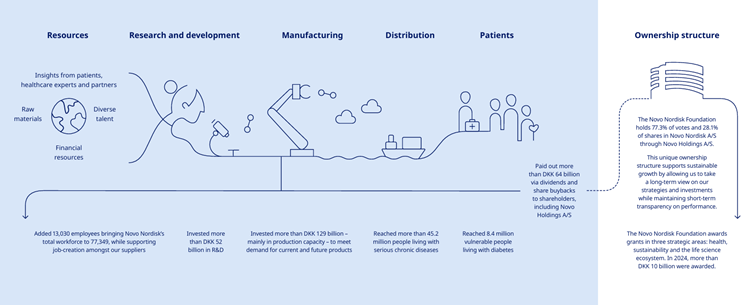
Because the conditions it treats are long-term and chronic, the revenue from those drugs is highly reccuring and predictable – lifetime value of each customer is very high.
In fiscal year 2024, the company archieved total sales of 290.40 million DKK (danish kroner). Let’s break this down by segments:
- Diabetes care (includes Ozempic & Rybelsus): 206.62 million DKK (71.15% of total revenue)
- Obesity care (includes Wegovy): 65,15 million DKK (22.43% of total revenue)
- Rare diseases: 18.64 million DKK (6.42% of total revenue)
As expected, Diabetes and Obesity care represent the vast majority or Novo’s sales, and those two segments are also biggest future growth drivers – especially Obesity care segment with Wegovy and upcoming oral version of the drug which is still in development phase, but could potentially enter the market in Q4 2025. USA currently remains the biggest market for obesity and diabetes treatment (roughly 40% of americans are obese). Hence, it’s logical that 58.48% of Novo’s sales from those two segments originate in United states.
Here is a chart that breaks down Novo’s revenue geographycally:
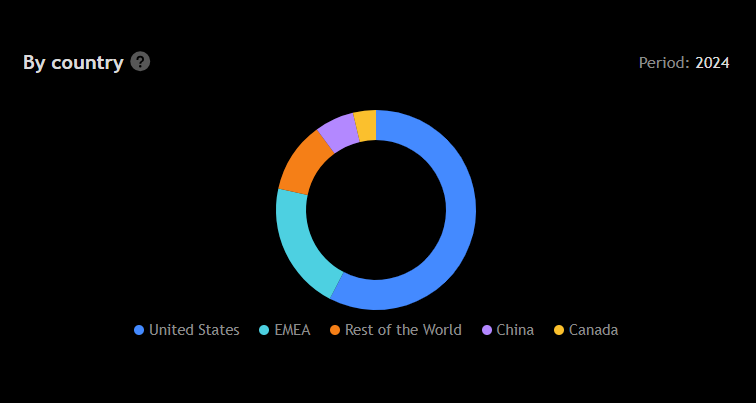
Overall, approximately 55–58% of Novo Nordisk’s revenue is derived from the U.S., followed by Europe (~20%), China (~10%), and the rest of the world (~12–15%).
Another crucial fact is that, a core molecule, semaglutide, underpins three of Novo’s largest products—Ozempic, Wegovy, and Rybelsus—making it a highly important asset. To mitigate concentration risk, the company is aggressively pursuing new formulations, indications, and delivery mechanisms.
Financially, Novo Nordisk’s model is capital-intensive but exceptionally efficient. In 2024, the company achieved a gross margin of approximately 85% and an operating margin near 44%, supported by the premium pricing power, which stems from a leading market position. Its return on invested capital (ROIC) remains consistently above 30%, reflecting great capital efficiency. In my opinion operating margin has pretty much peaked because of increasing competition and pricing uncertainty, but more on that later. The company has quite high capital expenditures, most a large part of those is directed toward icreasing production capacity (so called growth capex).
The crucial part of Novo’s future seccess is R&D spending and how successfully can introduce new and better drugs to the market. It’s pipeline looks quite promising: most important drugs in development are CagriSema, Amycretin and oral version of Wegovy – these are all in Obesity segment, which as I mentioned will probably remain key growth segment. But naturally there is a degree of uncertainty in successful commercialization of this drugs: for example CagriSema showed underwhelming results in its 1st stage III trial, hopefully next one will show more promising results.
INDUSTRY DYNAMICS
The market for obesity and Type 2 diabetes, in which Novo Nordisk operates, is characterized by long-term, non-cyclical conditions that create sustained demand for chronic therapies. As the world economically develops, obesity rates predictably increase and so does the demand for obesity drugs. Global health organizations project over 1.5 billion people will be obese by 2035, while diabetes already affects over 500 million individuals worldwide. As such, the total addressable market (TAM) for GLP‑1-based therapeutics is expanding sharply — to more than 150 billion by 2030 according to Grand View Research.
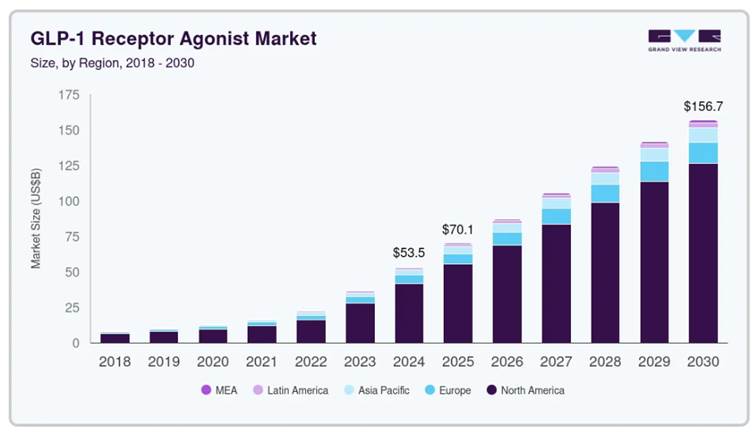
Payers and regulators are gradually warming to icluding those drugs in helathcare coverages, although resistance remains, particularly in public systems like Medicare.
Competition has intensified significantly. Novo’s main rival, Eli Lilly, markets tirzepatide under the brand names Mounjaro (diabetes) and Zepbound (obesity). Tirzepatide has shown superior efficacy in clinical trials compared to semaglutide — inducing up to 22–24% weight loss in some studies versus 15–17% for Wegovy. Moreover, Lilly has made aggressive moves to scale supply and introduce an oral GLP‑1 competitor (orforglipron). Amgen, Pfizer, and smaller biotech players are also planning to enter the market by pursuing differentiated delivery mechanisms.
Novo Nordisk retains a strong position, but it no longer operates in a monopolistic niche. Its competitive advantage lies in manufacturing efficiency (which is accomplished by scale), first-mover regulatory approvals, brand recognition and the most important being patent protection. But event this advantage is now being put to the test with the rise of Eli Lilly as Novo’s main competitor and with the emergence of so called compounding by pharmacies, which utilize legal loopholes to produce and sell copies of Ozempic and Wegowy at hefty discount compared to original drugs (I’ll talk more about this in the risks section). To help you picture this: Novo Nordisk’s US market share has fallen from over 70% in 2024 to around 60%. To draw a line; the company is still the market leader (in the US and glabally) with strong competitive advantage, but it’s slowly eroding as new player’s enter the market.
INVESTMENT THESIS
Now I’ll present my reasoning, why I think that Novo Nordisk might be an attractive investment opportunity at current price.
Novo Nordisk is well-positioned to benefit from one of the most powerful secular trends in healthcare: the global adoption of GLP‑1 therapies for obesity, diabetes, and associated metabolic disorders. Market estimates suggest the category could grow at an annual rate exceeding 15–20% through the end of the decade, supported by rising global obesity rates, improved reimbursement, and clinical evidence extending into cardiovascular and liver-related indications.
Despite increasing competition, especially from Eli Lilly’s tirzepatide (Zepbound, Mounjaro), Novo retains a leading market share in both diabetes and obesity treatments. Its manufacturing scale, established physician relationships, and growing pipeline—including oral formulations and combination therapies—support its position. While the moat is narrowing compared to a few years ago, Novo remains one of only two companies with the capacity and capabilities to compete globally in this space at scale. One of the most important potential catalysts is regulatory: Medicare does not currently cover anti-obesity drugs. However, bipartisan support is growing, and if legislation changes, it would significantly expand Novo’s addressable market in the U.S., particularly among older populations.
Yet the market remains preoccupied with short-term issues— compounder competition, GLP‑1 supply bottlenecks, pricing pressure, and political risk. These are valid concerns, but they are temporary. The company trades at just 13 times earnings, well below its historical average and peer multiples, despite high earnings growth, consistently high margins, a net cash balance sheet, and returns on capital above 30%.
This creates an opportunity for long-term investors. Novo is not a high-growth speculative biotech—it is a highly profitable compounder with global scale in a category that is still in the early stages of market penetration. As production capacity increases and reimbursement improves, earnings should grow at high single digits/low double digits rate over time. Any normalization in valuation could provide further upside. In my view, the market is underestimating Novo’s long-term earnings power and overemphasizing near-term noise. The valuation provides a margin of safety, while the business model offers attractive compounding potential.
RISKS
Now we arrive to perhaps the most important aspect of analyzing a business – determining risks that are associated with potential investment. As Warren Buffet famously said that the first rule of investing is to never lose money and the second rule is not to forget the first one.
Despite Novo Nordisk’s strong positioning and exposure to a structurally growing therapeutic class, several risks could materially affect its business.
1. Market Concentration Risk in GLP‑1 Franchise
Novo is increasingly dependent on the semaglutide franchise (Ozempic, Wegovy, Rybelsus), which now accounts for the majority of company revenue and profit. While lifecycle extension strategies are in place, this concentration creates vulnerability. Any safety concerns, unexpected side effects, or regulatory actions related to semaglutide could have outsized impact. Moreover, a significant portion of the company’s R&D pipeline and future growth expectations are tied to GLP‑1 and GLP‑1 combinations.
Patents on Ozempic and Wegowy expire in the early 2030s, and if till the the company doesn’t develop new profitables drugs, revenues might slip significantly. Increasing R&D spending can on the other hand decrease margins on the short-term, so the management has to find an optimal mix.
2. Intensifying Competitive Pressure — Branded and Unregulated
The GLP‑1 landscape is becoming increasingly crowded. Eli Lilly’s tirzepatide (Mounjaro, Zepbound) has demonstrated superior weight-loss efficacy in clinical trials and is gaining commercial traction in both diabetes and obesity. Additionally, large-cap players such as Pfizer, Amgen, and emerging Chinese biotechs are actively developing alternative GLP‑1 analogs and oral compounds, including next-generation incretins that could challenge semaglutide’s clinical edge.
Beyond these traditional pharmaceutical competitors, Novo faces a growing threat from compounding pharmacies, particularly in the United States. These operations are legally permitted to manufacture and sell unbranded versions of GLP‑1 drugs like semaglutide under Section 503A of the U.S. Federal Food, Drug, and Cosmetic Act, which allows compounding in cases of drug shortages and drug personalization.
While the shortage has officially ended months ago, The second, and more concerning, loophole – the “personalization” exemption – remains open. Under U.S. law, compounding is also permitted when a prescriber attests that the formulation has been “personalized” for a specific patient (e.g., different dosage, delivery method, or inactive ingredient). In practice, this provision is often loosely enforced, allowing large-scale compounders to operate in a gray zone that resembles mass manufacturing. Although Novo Nordisk is suing many of these compounders, it appers that regulators don’t have a sufficient motive to step up enforcement. And that’s why many analyst believe that this line of competition wil in some degree remain for a longer period – that makes it a material risk for Novo’s market position.
3. Political & Trade Risks
U.S. political actions pose potential near-term headwinds for Novo Nordisk, primarily through threats of pharmaceutical tariffs and aggressive drug pricing policies—both of which are external to the company’s core operations and not structurally tied to its business model.
Pharmaceutical Tariff Threats
President Trump has reignited discussions around placing steep tariffs on pharmaceutical imports, citing national security. Reports suggest potential rates up to 150% within 18 months, with extreme scenarios capped at 250%. While major drugmakers—including Novo—initially received exemptions, the persistent rhetoric and revived Section 232 investigations mean that tariffs remain a plausible risk. If enacted, tariffs could inflate supply chain costs or require costly reshoring of production—even though rivals are also likely to take similar strategic steps.
Most-Favored-Nation (MFN) Drug Pricing Mandate
In May 2025, an executive order directed U.S. federal agencies to align drug prices with the lowest prices found in comparable developed countries. This “Most-Favored-Nation” requirement aims to correct perceived global pricing disparities, potentially reducing U.S. drug prices by 30–80% or more. While legally and operationally complex to implement—and likely to face challenges—this policy represents a significant margin risk if enforced broadly.
These risks are best understood as externally driven and likely temporary in nature. They stem from shifting political priorities and trade policies rather than from any deterioration in Novo Nordisk’s business fundamentals. While they could lead to short-term pricing pressure or higher production costs—especially if tariffs are implemented or Medicare price negotiations expand—their impact is contingent on regulatory enforcement, legal challenges, and future electoral outcomes. Crucially, these developments do not undermine Novo’s long-term competitive position.
4. Supply Chain and Manufacturing Constraints
GLP‑1s are biologics requiring complex production, and Novo has already struggled with supply shortages—especially for Wegovy. If manufacturing scale-up efforts experience delays, cost overruns, or quality issues, it could restrict sales growth and weaken Novo’s competitive position, especially as Eli Lilly continues expanding its own capacity aggressively.
FINANCIAL ANALYSIS AND VALUATION
After reviewing strenghts and risks of this business, we will now, based on this information estimate the intrinsic value of Novo Nordisk. Based on the nature of the business I’ll use a discounted cashflows (DCF) method to calculated the intrinsic value, in addition to that, i’ll also calculate the expected annual rate of return of of this invetment at the current price as an internal rate of return.
But first I’ll determine Now I’ll devise 6 different scenarios – each will reflect the different degree to which the risks, oulined in the previous section, materialize and how will the company mitigate them. For each scenario, I’ll determine the ”normalized” net income for the 2025 – for that I have to estimate the expected operating margin – which is the starting point for DCF valuation. Then I’ll estimate the annual growth rate for net income for 3 different time periods: 2025-2031 (pre GLP-1 patent expiration), 2032-2034 (post GLP-1 patent expiration) and for the period beyond that (terminal growth rate). For the discount rate across all scenarios, I’ll use 15%, which is my goal for the long-term return of my invetment porfolio and includes the sufficient margin of safety.
Here is the description of each scenario:
Bear Case (weak):
- Market Concentration: Novo fails to develop sufficient new drugs in time to offset the loss of revenue from the GLP-1 franchise. R&D spending increases but does not yield profitable products soon enough, putting significant pressure on revenues.
- Competitive Pressure: Major competitors, including Eli Lilly, surpass Novo’s semaglutide in efficacy and market penetration, while compounding pharmacies operate unregulated, undercutting Novo’s prices.
- Political & Trade Risks: Pharmaceutical tariffs are enacted, and the MFN drug pricing mandate significantly reduces U.S. revenues, forcing Novo to restructure its operations and margins.
Operating margin: 36%
Growth rates:
2025-2031: 3%
2032-2034: -2%
Terminal: 0%
Bear Case (strong):
- Market Concentration: The company is highly dependent on semaglutide, with challenges around patent expiry. However, there are still some new profitable products in the pipeline, and R&D spending does not significantly harm margins.
- Competitive Pressure: Eli Lilly and others gain some market share in diabetes and weight loss, but Novo’s market position remains strong due to its brand and effective product defense. The gray area of compounding still poses a risk but is being handled.
- Political & Trade Risks: Tariffs and price controls are discussed, but the implementation is delayed. While pricing pressures exist, the impact on Novo’s earnings is mild.
Operating margin: 40%
Growth rates:
2025-2031: 6%
2032-2034: 2%
Terminal: 2%
Base Case (weak):
- Market Concentration: Heavy reliance on the GLP-1 franchise, but Novo Nordisk is managing to offset patent expiration with strong, though not perfectly successful, pipeline diversification.
- Competitive Pressure: While Novo remains competitive, competition from Eli Lilly and compounding pharmacies becomes more intense, slightly impacting market share but not a substantial threat.
- Political & Trade Risks: Minor tariffs and MFN pricing policies may be proposed, but they are likely to have limited impact on margins, and Novo’s global operations protect it.
Operating margin: 42%
Growth rates:
2025-2031: 10%
2032-2034: 4%
Terminal: 3%
Base Case (strong):
- Market Concentration: Moderate reliance on the GLP-1 franchise, with some successful diversification in the R&D pipeline.
- Competitive Pressure: The competition from Eli Lilly and compounding pharmacies is increasing, but Novo Nordisk maintains its competitive edge through strong brand and regulatory defense.
- Political & Trade Risks: U.S. pharmaceutical tariffs and drug pricing mandates remain unlikely, with only minor political pressures affecting pricing.
Operating margin: 43%
Growth rates:
2025-2031: 12%
2032-2034: 6%
Terminal: 3.5%
Bull Case (weak):
- Market Concentration: Though the company still relies heavily on semaglutide, its diversification efforts in R&D are progressing well, and the pipeline delivers a new drug that mitigates the decline from patent expiry.
- Competitive Pressure: Competition from Eli Lilly and compounding pharmacies is present, but Novo remains dominant in the market, fending off competitive threats with its superior formulations and regulatory defenses.
- Political & Trade Risks: No significant tariffs or drug pricing policies are enacted. Some political pressures may arise but are easily managed without a major impact on revenues.
Operating margin: 45%
Growth rates:
2025-2031: 15%
2032-2034: 10%
Terminal: 4%
Bull Case (strong):
- Market Concentration: The company significantly reduces its reliance on the GLP-1 franchise by successfully developing multiple new drugs that are as profitable, if not more so, than its existing portfolio. R&D spending is highly effective and helps drive top-line growth.
- Competitive Pressure: Eli Lilly and other competitors fail to catch up with Novo’s lead, while compounding pharmacies are sufficiently regulated, eliminating that threat. Novo continues to dominate the GLP-1 space with limited competition.
- Political & Trade Risks: Political and trade risks remain minimal, with the company benefiting from favorable regulatory environments. No price reduction policies or tariffs materialize, allowing Novo to maintain its pricing power and margins.
Operating margin: 48%
Growth rates:
2025-2031: 20%
2032-2034: 15%
Terminal: 4.5%
The main overall driver of revenue growth is the growing market for weight loss drugs, because of greater awarness and increased payer support – I believe that’s very likely during the next decade – the main factors of uncertainty are the impact of competition, other external factors and Novo’s ability to successfully monetize new drugs.
Now, I’ll calculate the DCF value and expected annual return for each scenario and then I’ll assign probabilities to each scenario, based on analysts’ consensus and my estimates and finally I’ll calculate the weighted average DCF value and weighted average annual rate or return (mathematically as an expected value).
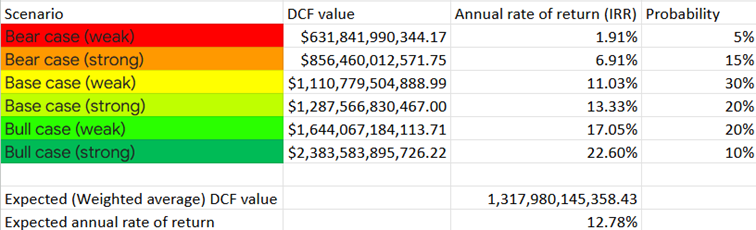
As you can see we get a weighted average DCF value of approximatelly 1.32T danish kroner, which is less that Novo’s current market capitalization, which, at the time of writing, stands at 1.44T danish kroner – share price of 323.05 DKK. Consequetly the expected annual return is also below my hurde rate of 15%.
If i would use i WACC for Novo, which would give a more objective intrinsic value figure, the stock would appear undervalued, but that’s not the case with my required rate of return as discount rate.
I’m also attaching the Excel spreadsheet so you can see in detail my whole valuation process.
PORTFOLIO DECISION
Given that the expected return is considerably below my required rate of return i won’t invest in the stock at the current price level. Although I think Novo Nordisk is a great business, there is just to much uncertainty about the impact of competition and company’s heavy reliace on GLP-1 molecule to justify the current valuation, while still leaving room for margin of safety. I also don’t find it suprising that it isn’t significantly undervalued, as it’s a pretty big and known company, so the new information get priced in quickly, because a lot of analysts and investors are closely following the stock.
But the stock isn’t heavily overvalued either; I’d consider opening a position, if the stock would have fallen about 10% from the current price, which has happened when I was still analyzing the company, but then it rebounded back up. So I’m going to put it on my watchinst and follow closely for any potential price drops.